Chairman
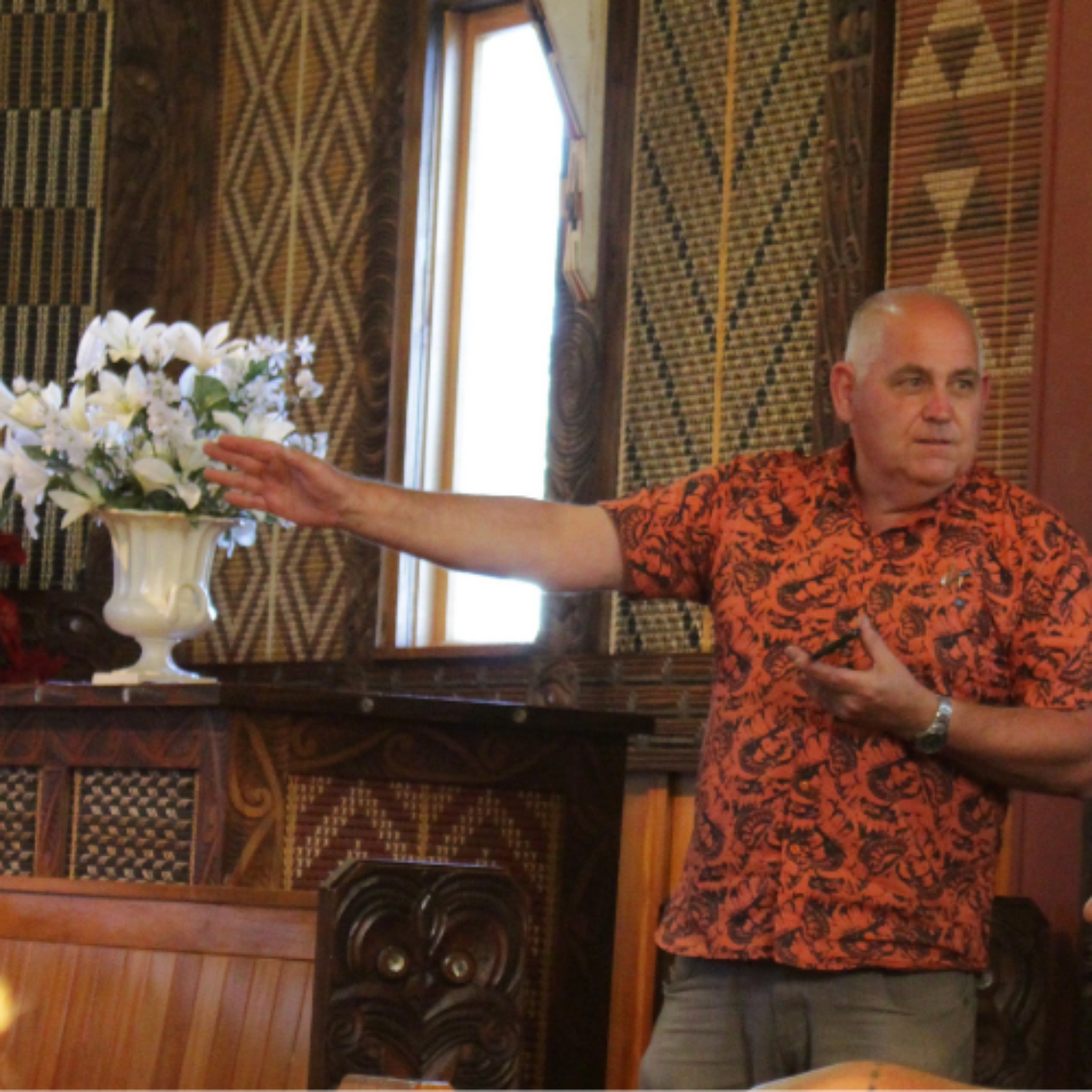
Nick Rāhiri Roskruge (Ātiawa, Ngāti Tama-ariki) is a retired Professor in Ethnobotany and Horticulture and a research fellow with Ngā Pae o Maramatanga (the National Māori Research Centre) and Chairman of the Data Repository committee for Genomics Aotearoa a Centre of Research Excellence based at Otago University in NZ.
Nick is from Taranaki in the North Island of New Zealand and continues to be involved in ongoing Māori development activities and tribal interests there. In 2013 he was awarded a Fulbright award and spent time at Cornell University (New York) and a number of other US state universities around ethnobotany and potato genomic programmes. Currently he is also a member and chairman of the Indigenous and Local Knowledge Taskforce for IPBES based in Paris, France.
Nick is involved in a wide range of Māori and Pacific horticultural projects and is the Chairman of Tahuri Whenua (National Māori Horticultural Collective). His professional activities centre around farmer training, food security and crop systems aligned to New Zealand, the South Pacific nations especially Papua New Guinea, Fiji and Samoa and the Americas, particularly Chile and Peru.
Convenor
As a Senior Environmental Research Scientist, Federico works at the intersection of data science and New Zealand’s biosecurity. His work revolves around unlocking the potential of Digital Agriculture through advanced spatial-temporal modelling. A highlight of his recent work is his publication in Smart Agricultural Technology, detailing a novel approach to predicting grass grub distributions using satellite data and machine learning. Beyond his primary research, Federico supports the Better Border Biosecurity (B3) collaboration, ensuring that New Zealand’s national biosecurity strategy is informed by world-class statistical analysis and cutting-edge data technology.
Waipaina Awarau is of Ngāti Porou descent and was raised in Waipiro Bay on the East Coast of Aotearoa New Zealand. She is a botanist trained in Queensland, with specialist expertise in seed conservation through the Millennium Seed Bank in the United Kingdom.
Her work focuses on advancing community-led biosecurity responses that bring together mātauranga Māori and science. She advocates for hapū-led kaitiekitanga, recognising that enduring and effective plant protection solutions are grounded in the knowledge, leadership, and resilience of local communities.
Waipaina has represented Māori as tangata whenua, and as a botanist, in seed banking and biosecurity responses across Aotearoa New Zealand, Australia, and England. She is currently a Scientist/Kairangahau at Bieoeconomy Science Institute Maiangi Taiao, where she leads biosecurity kaupapa within B3 Better Border Biosecurity.
Tom is an Invasion Ecologist and Portfolio Leader for Establishing Indigenous Forests at the Bioeconomy Science Institute. His research interests include how species invasions are facilitated by niche or trait shifts, and encompass the full spectrum of spatial and temporal variation (local–global; present–future). In recent years he has focused primarily on plant invasions, but has also worked on developing models for pest and pathogen spread under climate change. Toms current role now focuses on safeguarding and improving the establishment success of indigenous trees and ecosystems.
Tom is the current President of the New Zealand Plant Protection Society.
Ronny Groenteman leads research on classical biological control of weeds at the Bioeconomy Science Institute, based at Lincoln, New Zealand. She leads research to improve safety, effectiveness and cost-effectiveness of weed biocontrol, as well as leading the development of multiple active weed biocontrol programmes. More recently she is focusing on integrating indigenous knowledge into the practices of weed biocontrol.
John Hampton is Professor of Seed Technology at Lincoln University and Director of the Lincoln University Seed Research Centre. His MAgSc degree was in Plant Pathology, and he has many years of experience with seed-borne pathogens and their control. His research interests include the development of biocontrol formulations delivered via seed. John currently leads a multiorganizational research team investigating the ability of seed delivered fungal volatile organic compounds to mitigate both abiotic and biotic stress in plants.
Eirian is a Professor of Plant Pathology at Lincoln University, New Zealand, and a researcher in the Bioprotection Aotearoa Centre of Research Excellence based at Lincoln University. Her main research area is the development of sustainable control strategies for plant diseases with a particular focus on biological control of plant pathogens and the role of endophytic microorganisms in disease suppression and improved plant growth. She has supervised more than 50 postgraduate students and delivers undergraduate courses in plant protection and plant pathology.
Wadia Kandula is an applied plant pathologist specialising in biological control (using Trichoderma bio-inoculants and Fungal volatile organic compounds) of soil-borne fungal diseases. He has 48 years of research experience covering epidemiology of soil-borne and foliar diseases, disease & drought interaction, and aerobiology of several plant pathogens affecting a range of crops.
Wadia is the current executive secretary of the Australasian Plant Pathology Society.
Virginia is a Plant Pathologist at the the Bioeconomy Science Institute in Lincoln, Aotearoa New Zealand, and a researcher with the Bioprotection Aotearoa Centre of Research Excellence at Lincoln University. Her research focuses on the epidemiology and sustainable management of plant diseases, particularly in stone fruit systems, alongside biosecurity research addressing invasive and emerging plant pathogens across a range of host species.
Virginia is the current vice-president of the New Zealand Plant Protection Society.
Dr. Paudel is a Senior Scientist at Bioeconomy Science Institute, specializing in applied entomology and insect pest management with a focus on transboundary and invasive pests through enhanced surveillance, biosecurity, and integrated pest management (IPM) strategies. Originally from Nepal, he holds a Ph.D. and M.Sc. from Pennsylvania State University, USA.
Dr. Paudel's experience spans diverse regions, including Bangladesh, Bhutan, Cambodia, Nepal, New Zealand, South Pacific Island nations, and the United States, where he has led and contributed to projects involving a wide range of pest species. Currently, his work emphasizes on biological control and remote surveillance of insect pests in the South Pacific Islands. Dr. Paudel is passionate about advancing international development through science and serves as the International Association for the Plant Protection Sciences (IAPPS) Coordinator for Oceania.
Grant is the Science Team Leader of the Pathogen Biosecurity Environments team based at the Plant & Food Research Group of the Bioscience Science Institute in Lincoln, Aotearoa-New Zealand. Grant is a Plant Pathologist who has worked in both Australia and New Zealand on a range of viral, bacterial and fungal pathogens (and appropriate vectors) across a range of sectors.
He was Contract Manager of the first phase of the Better Border Biosecurity (B3) research collaboration (2005-2009), and Program Leader of the Effective Detection and Response Program of the Canberra-based Plant Biosecurity Cooperative Research Centre (2013-2018). Since 2015, he has been an Instructor at the Plant Biosecurity in Theory and Practice Course at The Biosecurity Research Institute at Kansas State University and has co-supervised a number of graduate students at New Zealand and Australian Universities.
Grant is the current Immediate Past President of the Australasian Plant Pathology Society.
Mesulame (Mesu) Tora, MSc, BA, is an indigenous Fijian (iTaukei) and early career researcher with the BioProtection Aotearoa (BA) - Pasifika cohort. He is currently pursuing a PhD in Soil Microbiology focussing on soil biodiversity and ecosystem functions in the Pacific Island Countries and Territories (PICTs). With previous work in seed banking and germplasm material conservation, Mesu’s impactful work spans across various sectors, including iwi, industry, and university in New Zealand and the PICTs. He was the recipient of the REaDI and Strategic Research Excellence Fund Award (SREF) from Massey University for the period 2022-2023. In 2016, Mesu received the Pacific Emerging Professionals Program Award collaborating with the University of Hawai'i at Manoa (UHM) and Lyon Arboretum, understudying the intersection of traditional ecological knowledge and contemporary conservation practices around plant protection. He expanded this experience working with Ngāti Kahungunu ki Wairarapa in 2018 developing a framework for response to biological incursion based on key elements of mātauranga Māori and using the myrtle rust incursion in New Zealand as a case study. This work later contributed towards his commitment with the New Zealand Flora Seed Bank (NZFSB) focussing on long term conservation of Aotearoa native plant species as an essential insurance policy.
Joel Vanneste is a principal scientist at the Bioeconomy Science Institute in Hamilton. He is the co-recipient of the 2017 New Zealand Prime Minister’s Science Prize for his contribution to the recovery of the New Zealand kiwifruit industry from the outbreak of Pseudomonas syringae pv. actinidiae; and of the 2018 Kudos Science Trust Agricultural Science Award for his work on biological control of plant pathogens. The focus of his laboratory is on developing novel ways to control bacterial pathogens including the development of biological control agents and novel elicitors. His laboratory is also studying the role of the bacterial and fungal microbiomes on disease incidence and in understanding the spread of antibiotic and copper resistance in bacterial populations associated with kiwifruit plants.
Joel is the current Australasian Plant Pathology Society Councillor for North Island New Zealand.
Jessica is the Science Team Leader of the Insect Dynamics, Ecology, and Sustainability team, and is based at the Bioeconomy Science Institute in Lincoln, Aotearoa / New Zealand. She was trained as an entomologist and plant pathologist at Wageningen University in The Netherlands, from which she received her PhD in Plant Pathology. Her research focuses mainly on (invasive) insect vectors and the plant pathogenic organisms they may transmit: where are they in the environment, how they interact with each other and crops, and how to sustainably manage them using Integrated Pest Management, alongside biosecurity preparedness research. She also is the Theme Leader for Surveillance & Response in the Better Border Biosecurity (B3) research collaboration.